Body Repair: Why It Is Better Done at a Professional Centre
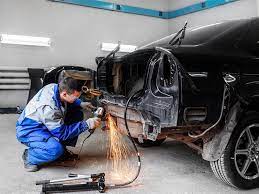
For quality body repair, it is best to leave the job to professionals.
For every car owner, body repair is an unwelcome necessity they would rather face only as a last resort. That feeling has less to do with the cost than with the fear of getting poor-quality service. Body repair can be done at a specialised centre, at a small garage workshop or at a service station. The latter often attract customers with low prices and quick turnaround. If the owner knows cars well, understands how each stage of the repair should be done and is prepared to supervise the process, the garage workshop option may work for them. It is also possible to repair the body yourself, but that isn’t for everyone because of the costs involved.
The car owner has to establish in advance how qualified the specialists they are entrusting their car to really are, and find out what tools and equipment the workshop has. In this situation, there is no guarantee of a quality result.
Unlike small workshops, a specialised body repair centre ensures high-quality work through regular staff training and professional development. The team’s experience is backed by a large number of successfully repaired cars of various makes. Such centres provide a warranty on the work performed. Many operations during a repair produce results the customer cannot see, and checking their quality straight away is difficult. We recommend choosing centres that offer a warranty of at least 6 months.
Successful body repair depends not only on the technicians’ skills but also on the availability of specialised equipment. A modern body repair centre must be fitted with modern machinery. Every operation requires specific equipment, and sometimes an entire technological system.
Panel beating, for example, is a demanding operation that requires a wide arsenal of tools for straightening dents and preparing the surface. Modern systems offered by global companies make it possible to remove defects without damaging the paint. Complex cases, however, call for specialised machinery.
Body welding is another demanding operation that requires strict adherence to the technology. Welding may be used to deal with corrosion or to replace parts. The quality of the welding affects the car’s long-term service life. Professional technicians use specialised welding systems for different types of work.
It is worth noting that the «car painting in Almaty» body repair centre is equipped with machinery from Wielander+Schill, a company with a strong reputation in the car repair industry. This guarantees high-quality work, including panel beating and welding.
Restoring body geometry
After a serious accident, visible deformation of the car body requires a whole set of measures to correct it. Beyond the obvious damage, however, there is also hidden deformation, which may show up, for example, as doors or a boot lid that no longer close properly. Even minor incidents, such as a wheel dropping into a pothole or hitting an obstacle, can shift or deform components. To determine the extent of the damage, the body geometry control points specified by the manufacturer in the dimensional drawings have to be checked.
No matter how experienced and skilled the specialist, this operation cannot be done by eye; a measuring bench is required. The readings are compared against a database containing the geometric specifications of cars of various makes and models. After the diagnostics, the computer reports any deviations in geometry. For an accurate assessment of the deviations, the database must be constantly updated with new car models.
Body geometry cannot be restored effectively without a dedicated pulling bench. On such a frame rack, practically any damage can be corrected and the car returned to its factory shape. The vehicle is clamped to the platform and the damaged section is pulled to the required dimensions. Modern geometry restoration systems are expensive, sophisticated technological systems that only large body repair centres can afford.
The company «Car painting in Almaty» uses professional equipment from Wedge Clamp to restore body geometry. The Canadian company Wedge Clamp has specialised in developing dedicated vehicle geometry restoration systems since the early 1980s. The Wedge Clamp pulling bench handles body work of any complexity effectively. The direction and force of the pull are adjusted using two power units. After all the work, the body geometry conforms to the factory standards set by the manufacturer.
Colour matching systems
After body work, parts or the whole car often need to be painted. With partial or spot painting, precise colour matching is especially important to achieve a uniform finish with the rest of the surface. Owners often choose this method to reduce the cost of the repair. Here it is important not only to apply the paint correctly but also to match the car’s shade exactly. Technicians use tinting charts, yet the painted parts often still differ slightly from the rest. The difficulty lies not only in finding the colour code in the catalogue but also in accounting for the texture and tone of the paintwork, which are affected by external factors.
To guarantee a colour match, there are matching systems from major global manufacturers. Spies Hecker is one example. It provides a technology for creating the required colour from standard components. A wide range of components makes it possible to mix hundreds of thousands of shades. Their range includes two-component coatings, base coats with effects, clear coats, primers and other materials.
A professional colour matching system built into a body repair workshop should include the following components:
High-quality paint materials and consumables from leading manufacturers.
Special equipment for precise colour matching, including lamps, motorised mixing racks, scales, dosing lids and so on.
Reference documentation such as catalogues, colour guides, paint samples on test panels, etc.
A computerised colour matching system with an extensive database of car makes.
A workshop equipped with such a tinting system can ensure an exact colour match on any surface being painted.
Spray booth
Painting the car body is the final stage of the repair process. Paint is applied to a surface prepared during the preceding stages. After each coat, you have to wait for it to dry completely before applying the next. It is important that the painted surface dries evenly at the temperatures recommended by the manufacturer. During painting, the room must be kept clean and dust and impurities in the air minimised. Once the paint has been applied, a layer of clear coat goes on top, which is polished after drying.
The spray booth is an essential piece of equipment in a body repair centre. It is where the painting and drying of both whole car bodies and individual panels take place. A special ventilation system inside the booth provides the right conditions for painting. Equipment from USI ITALIA makes it possible to paint cars of various makes. This company’s modern booths combine the latest technological advances in automation, design and environmental safety. Inside the booth, efficient ventilation and heating of the air to optimal values are ensured. It is also fitted with air purification filters and special lighting for checking the paintwork in hard-to-reach areas of the body.
The absence of a dedicated spray booth, or the use of equipment from unknown manufacturers, can lead to paint defects caused by dust contamination and errors during drying. Correcting such mistakes will require additional time and money.
The «car painting in Almaty» body repair centre provides body restoration services for cars of various makes, both passenger and commercial.